Community Grant Recap: Berkshire Regional Planning Commission Takes on Plastics
Written By Agnes Cheng, Training Associate
Plastic waste has been a fixture of public imagination and environmental advocacy for decades, visible in polluted landscapes both close to home and around the world. In response, bottle bans and plastic bag bans have spread across the states, giving municipalities a clear, popular way to fight back against the most visible forms of plastic pollution. When the Berkshire Regional Planning Commission (BRPC) approached the Toxics Use Reduction Institute (TURI) with a grant proposal, they aimed to complement existing legislation with public education, conversation about plastic use and reduction, and vetted resources.
Through this work, BRPC hoped to build knowledge and seed action, both with their organization and across their network of towns, on the issue of microplastics and chemicals in plastics.
A history of collaboration
TURI has a long history of funding community groups. The goal is simple, to allow groups to take on projects that would otherwise be out of reach, either because of staff capacity or technical grounding or a combination. In exchange, TURI is introduced to and immersed in trusted relationships that community groups have spent years, sometimes decades, building.
This project is a good example of that exchange in action. TURI brought technical expertise and vetted resources to the table. BRPC brought the local knowledge, the relationships and the sense of where the gaps actually were in their community.
Take the restaurant outreach piece of the project. Jazu Stine, BRPC’s Public Health Food Specialist and veteran of the restaurant industry, didn’t need to introduce himself to the restaurants he visited for this project, he’d already built rapport with them over years on the job. That meant he could have real conversations about going plastic-free, hearing the questions, the enthusiasm and the hesitations directly from the people who’d have to make the change. Meanwhile, TURI provided background information on the hazard of plastic chemicals and connected BRPC with organizations like the Center for Environmental Health, which has deep expertise in plastic-free and reusable food ware, so BRPC didn’t have to build that knowledge base from scratch. The partnership reduced duplicated effort and allowed the project to move faster than either organization would have moved alone.
Summary of the project
BRPC structured its work around three core goals: build internal knowledge on microplastics and educate the public, have conversations with restaurants about reducing plastic use, and develop a municipal toolkit for towns considering plastics-related bylaws.
Education and Outreach on Microplastics
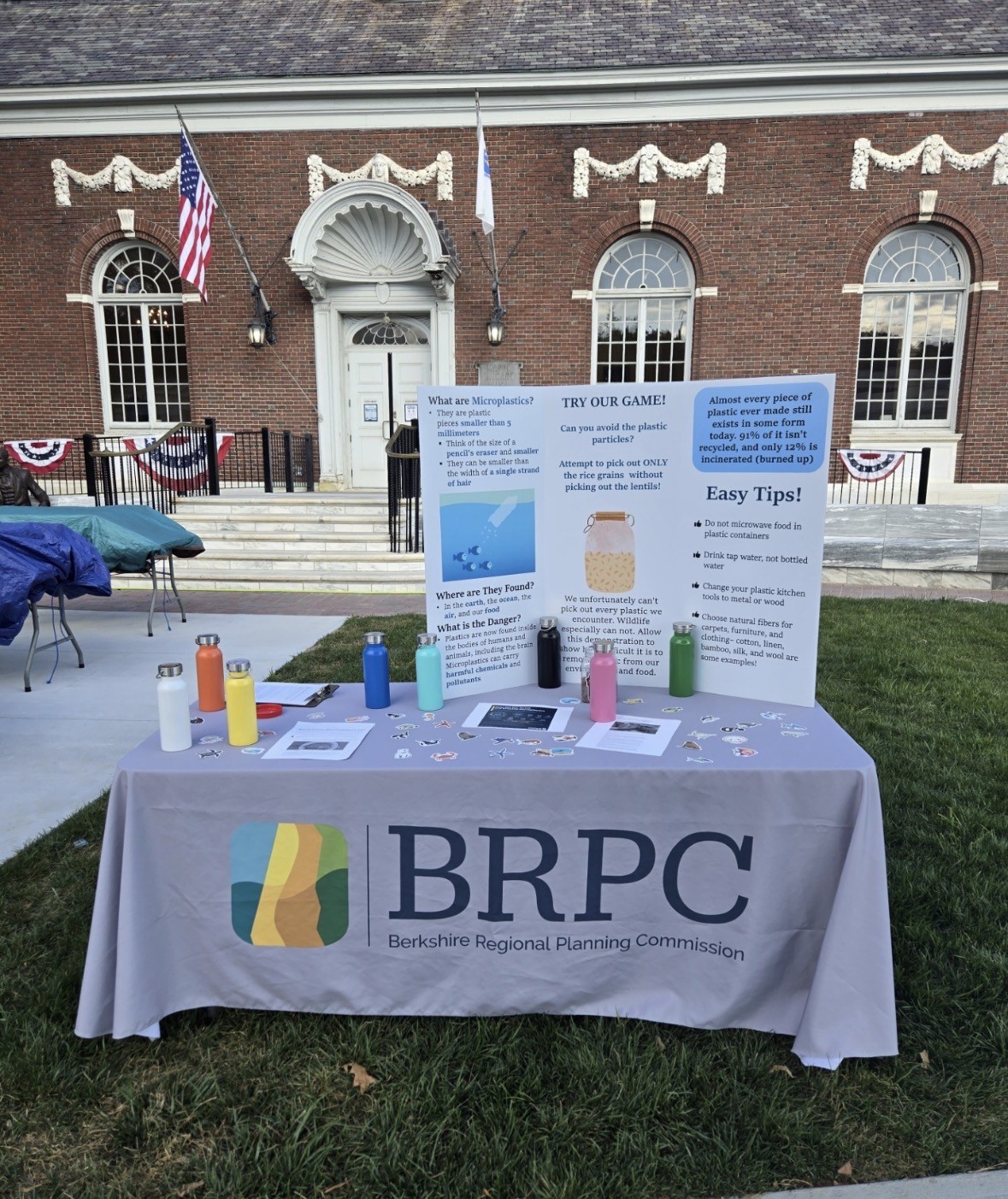
BRPC developed posters and handouts covering the basic health and environmental issues tied to microplastics, a topic they had noted was gaining public awareness. They disseminated that information through newsletters, emails and in-person events across the Berkshires, and found people surprisingly engaged.
Along the way, BRPC built up its own staff’s foundational knowledge, hosted a number of conversations with stakeholders and even organized a screening of The Plastic Detox, a documentary that happened to be released during the project’s run.
Lesson learned from Jaymie Zapata, Public Health Planning Program Manager at BRPC: In-person communication matters. Tabling events and community meetings were where the real engagement happened. Interest in microplastics is high, but people’s bandwidth to seek out information on their own is limited, so it’s on organizations like BRPC to show up where people already are, whether that’s a farmers market or the local library.
Plastic Reduction in Restaurants
BRPC brought resources and conversations about plastics to their inspection visits. The response was largely appreciative and curious. Interestingly, BRPC found that many institutional food service operations, like assisted living facilities and schools, had already taken meaningful steps to cut down on single-use plastics.
The challenges were real and Jazu Stine, who led much of this outreach, put it plainly:
“…What was expressed was more along the lines of barriers and concerns. For the most part it boils down to time or money, which are essentially the same in a kitchen. More than ever, small food businesses are struggling. COVID did irreparable damage to the food industry workforce, food prices are at an all-time high, and every plate is under a social media microscope….”
His advice for anyone doing this kind of outreach:
“Building a relationship of trust and education is essential to offering suggestions of change. Meeting owners where they are, understanding their struggles, and being very respectful of their time are all critical to changing how food service views the role of public health.”
Municipal Toolkit for Plastics Bylaws
The third piece of the project was a policy toolkit to help towns and municipalities think through plastics-related bylaws. BRPC researched existing bylaws across the state, how they’re written, how they move through local government and turned that research into practical guidance. From there, BRPC staff engaged directly with towns to talk through bylaw strategies and other options.
Lesson learned: The plastics policy landscape in Massachusetts is moving fast. Keeping the toolkit current amid a steady stream of legislative updates was a real challenge throughout the project. Still, bylaws matter and they’re one of the clearest ways a town can signal to state and federal lawmakers what its residents care about.
Across all three goals, the biggest challenge wasn’t a lack of interest or a lack of good ideas, it was capacity. Many town boards in the Berkshires run on volunteer labor, with members holding down day jobs alongside their governance responsibilities. BRPC itself covers an enormous range of work, from housing development to public health education.
TURI’s support made a concrete difference in terms of funding, staff capacity and, maybe most importantly, a shortcut through existing technical knowledge that would otherwise have taken months to build from scratch. But plastics issues span environmental, business and public health fields and that breadth is exactly why longer-term investment matters. Investments like this one are how communities build the trusting relationships and shared knowledge base needed to keep pace with the issues that matter most to residents.
What’s Next
This particular grant has wrapped up, but the conversation around plastic use and waste, microplastics and chemicals in plastics continues at the local, state, federal and international levels.
As for BRPC, the team plans to keep engaging with community questions on plastics, weaving the resources and relationships they’ve built into their ongoing work. The knowledge and enthusiasm they’ve built up over the course of this project is a genuine asset and one well worth following.
Link to BRPC Plastics Reduction Bylaws Toolkit: https://berkshireplanning.org/wp-content/uploads/2026/06/Municipal-Toolkit-for-Plastics-Reduction-Bylaws.pdf

