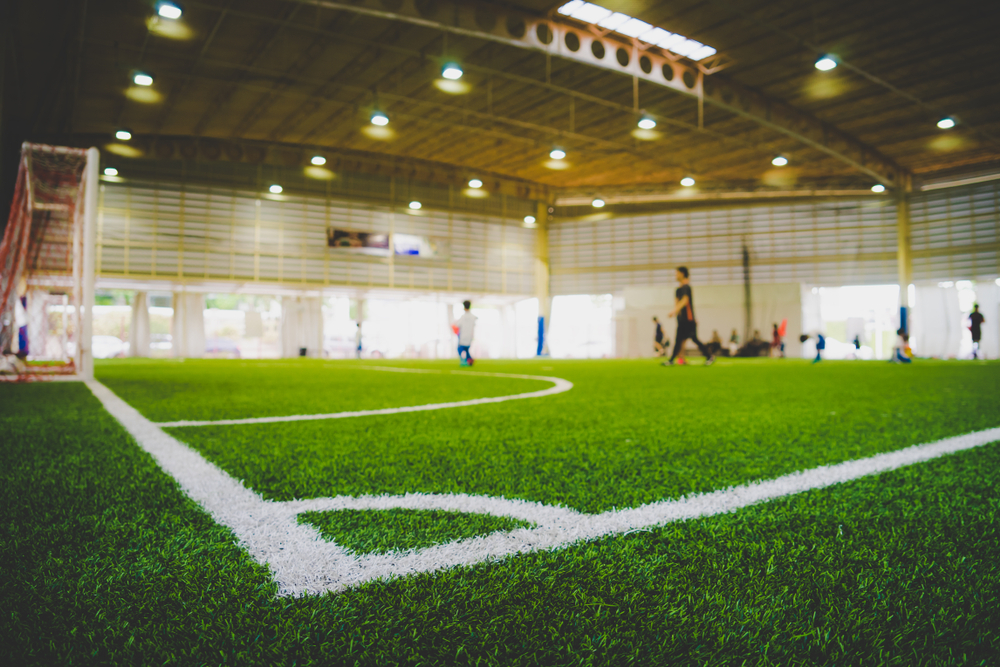
Artificial Playing Fields
We receive many questions from communities asking about health and environmental issues associated with artificial turf and safer alternatives for athletic and playing fields. If your community is trying to make a decision about whether to install artificial turf or manage grass fields organically, the information and resources on this page can help.
Featured Documents
Artificial Turf Factsheet
This fact sheet introduces some of the considerations that are relevant to evaluating natural grass and artificial turf playing surfaces.

PFAS in Artificial Turf Carpet
The Massachusetts Toxics Use Reduction Institute (TURI) has received inquiries from municipalities and community members regarding the presence of per- and poly-fluoroalkyl substances (PFAS) in artificial turf carpet. This brief fact sheet provides some basic background information on PFAS and on recent testing for these chemicals in artificial turf as reported by nonprofit organizations. This information is provided under TURI’s mandate to provide information on toxic chemicals and safer alternatives to businesses, municipalities, community members and others.

Athletic Playing Fields Choosing Safer Options for Health and the Environment
Municipalities, universities, schools and other institutions frequently need to make decisions about maintenance and installation of athletic playing fields.
Building an Organic Maintenance Program for Athletic Fields: Guidance from Experts and Experienced Communities
Natural grass fields can provide a protective, high-performance surface for athletic activities. Organic field maintenance practices can improve the health of soil and grass without the need for synthetic pesticides or fertilizers.
Resources
TURI and the Lowell Center for Sustainable Production have gathered resources about artificial turf and its alternatives, including organically managed grass fields. The collection includes fact sheets, reports, journal articles and case studies for communities, local governments, and individuals, helping readers make informed choices about artificial turf.
-
Artificial Turf
- Artificial Turf Concerns Summary – Flyer
- Athletic Playing Fields: Choosing Safer Options for Health and Environment – Report (2019)
- Athletic Playing Fields and Artificial Turf: Considerations for Municipalities and Institutions – Fact Sheet (2020)
For a more in depth discussion of artificial turf and its chemical contents, please review the following alternative assessment and reports for artificial turf infill and turf materials.
- Sports Turf Alternatives Assessment (2017)
- Artificial Turf Infill: A Comparative Assessment of Chemical Contents – Peer reviewed journal article (2020)
- Testing Artificial Turf Materials: Options and Lessons Learned – Report (2021)
- TURI Comments on Washington State Department of Health Report (2017)
-
Organically Managed Grass Athletic Fields
Across Massachusetts, communities and homeowners are making the choice to manage grass organically, rather than using chemical fertilizers and pesticides.
TURI has also compiled information on organic maintenance techniques from experts and successful communities into a guide to help communities build an organic management plan for athletic fields and lawns.
TURI released a series of case studies highlighting communities that use organic maintenance to improve and build healthy grass playing fields. Each of these case studies provide detailed information on playable hours, maintenance practices, and costs.
- Natural Grass Playing Fields Case Study: Denison University, Granville, OH – Case study 2021 (pdf)
- Natural Grass Playing Field Case Study: Southwest Pennsylvania – Case study 2021 (pdf)
- Natural Grass Playing Field Case Study: Martha’s Vineyard, MA – Case study 2020 (pdf)
- Natural Grass Playing Field Case Study: Marblehead, MA – Case study 2019 (pdf)
- Natural Grass Playing Field Case Study: Springfield, MA – Case study 2019 (pdf)
-
PFAS in Artificial Turf
Many efforts have focused on better understanding PFAS in artificial turf. The resources that follow are provided to help decision-makers and community members make informed decisions.
- PFAS in Artificial Turf Factsheet (TURI, 2020)
- PFAS in Artificial Turf: Academic, Municipal and Other Testing Results (Lowell Center for Sustainable Production, 2024)
- PFAS in Artificial Turf Test Methods (Lowell Center for Sustainable Production, 2024)
- New Jersey Department of Environmental Protection, “Technical Memorandum: PFAS in Artificial Turf” (2023)
-
Playground Surfacing
Please see the report below for information on choosing safer materials for playground surfacing.
-
Webinars
- Poolesville Green: Safer Playground Surfaces: Protecting Kids’ Health (2023)
- Cancer & Environment Network of Southwestern PA: Health and Environmental Hazards of Artificial Turf and Safer Alternatives (2023). Passcode: q+AckJw1
- Collaborative on Health and the Environment (CHE): Environmental Health Impacts of Synthetic Turf and Safer Alternatives (2022) (Also see: CHE 2022 Webinar: Questions and Answers)
- Healthy Building Network (HBN): Selecting Athletic Turf You Can Feel Good About (2020)
- Sports Fields: Assessing the Alternatives (2018)
-
Frequently Asked Questions
What are the concerns about chemicals found in in artificial turf infill made with recycled tire crumb?
A large number of chemicals are found in tire crumb. Many of these have adverse effects on human health or the environment. Some of the chemicals found in tire crumb are endocrine disrupters (e.g., phthalate esters); some are known or suspected carcinogens (e.g., arsenic, cadmium, benzene, styrene); and some are associated with other human health effects. For example, polycyclic aromatic hydrocarbons (PAHs) in tire crumb infills are a particular concern due to carcinogenicity. As of August 2022, eight PAHs in tire crumb infills will be subject to new limits in the European Union.
Children are uniquely vulnerable to the effects of toxic chemicals because their organ systems are developing rapidly and their detoxification mechanisms are immature, among other factors. For these reasons, it is particularly important to make careful choices about children’s exposures. For more details:
- See the “Tire Crumb” section (page 4) of the TURI report “Athletic Playing Fields: Choosing Safer Options for Health and Environment.”
- See TURI’s detailed document on tire crumb.
- Watch this video to hear from public health expert Dr. Richard Clapp.
Do you have information about other topics, such as heat, environmental impacts or snow removal?
Use of artificial turf presents a number of issues other than human health concerns related to chemical hazards. Refer to pages 11 through 13 of the report “Athletic Playing Fields: Choosing Safer Options for Health and Environment” and the Physical Hazards document for more details on the topics described below.
Heat: In sunny, warm weather, artificial turf can become much hotter than natural grass, raising concerns related to heat stress for athletes playing on the fields. Some towns, such as Burlington, MA (under “Foundations and Basic Commitments,” then “Section E – Support Services”) have adopted policies to protect athletes from high temperatures. For more information on approaches to determining safe temperatures on play surfaces, see page 2 of Athletic Playing Fields and Artificial Turf: Considerations for Municipalities and Institutions.
Environmental concerns: Environmental concerns include loss of wildlife habitat and contaminated runoff into the environment. Another environmental concern is migration of synthetic particles, including infill and plastic grass blades, into the surrounding environment. In 2020, reuse of turf in a construction project led to the release of a large quantity of crumb rubber into the Puyallup River in Washington State. Recent findings indicate that a chemical found in tires is responsible for mortality of coho salmon in the Pacific Northwest.
Snow removal: Manufacturers recommend using specialized equipment for removing snow for winter play, such as snow blowers designed for turf fields. One Massachusetts town estimated the cost for snow blowing the field would be $5,000- $10,000 per snow storm. Damage caused to a field during snow removal could impact the warranty of the field. Snow removal may also remove infills or fibers from the field, moving them into the environment. Local conservation regulations may restrict snow removal from fields depending on proximity to wetlands, waterways, or other protected lands.
Disposal: Artificial turf fields are typically replaced every 8-10 years. Some synthetic materials may be reusable or recyclable, though recycling options are often limited. Others may have to be disposed of in a landfill or through incineration when the field is due for replacement. Challenges related to disposal are discussed in The Seattle Times, The Atlantic, Environmental Health News, and Zembla.
Injuries: One particular concern is increased rates of turf burns (skin abrasions) associated with playing on artificial turf. These abrasions are a risk factor for serious bacterial infections. More information can be found in the fact sheet, “Athletic Playing Fields and Artificial Turf: Considerations for Municipalities and Institutions.”
How can I learn more about organically managed grass fields?
We have compiled information from athletic field landscaping professionals, as well as lessons learned by individual communities that are successfully maintaining their athletic fields with organic practices into a guide to help communities learn how to transition to organic grass management. Please see the resources above, under “Organically Managed Grass Fields,” or visit some of these external resources.
- The Field Fund– offers both supplemental maintenance and renovations of playing fields, and training, with the goal of improving the quality of recreational spaces in Martha’s Vineyard
- Midwest Grows Green– initiative of the Integrate Pest Management institute, focused on sharing pesticide and fertilizer reduction information
- Grassroots Environmental Education– a New York-based educational non-profit organization, focused on educating the public about the links between common environmental exposures and human health
- Beyond Pesticides – offers an organic land care management program as well as other resources for field, greenway and park management.
For personalized help with grass field issues, or converting a field to organic management, a consultant can be a helpful resource. Below are a few that specialize in organic athletic fields and work in Massachusetts. Note that TURI does not endorse any specific provider.
How much play time can you get on organically managed grass?
Many parents, athletic directors and town administrators have contacted us with this question. According to organic grass athletic field experts, the key to a well-functioning field is healthy soil and a healthy grass root system. Individual fields can be diagnosed and maintained in a way that addresses specific issues and performance needs.
Take a look at the Springfield case study to find the number of hours played at three organically managed grass fields. If you want to estimate the number of playable hours on a soccer field in your community, you can use Treetop Park, the full-sized soccer field, as an example. Treetop Park is used for approximately 1,050 hours of practice, games, and informal activity annually.
We’ve also documented playing time on fields in the Marblehead case study. The town has maintained high quality, organically managed grass fields for more than 15 years. In the case study, you’ll find hours of use per week for four town fields, which are used for field hockey, baseball, lacrosse, soccer and more.
If you want to estimate the number of playable hours on a football field in your community, you can use Hopkins Field, the full-sized football field, as an example. This field was used for multiple sports and recreational activities for a total of 1,860 hours in 2018.
You can also view hours of use in our Martha’s Vineyard case study.

Featured Video:
Three Massachusetts Communities Maintain Athletic Fields Organically

Featured Video:
Alternatives for Athletic Fields

Featured Video:
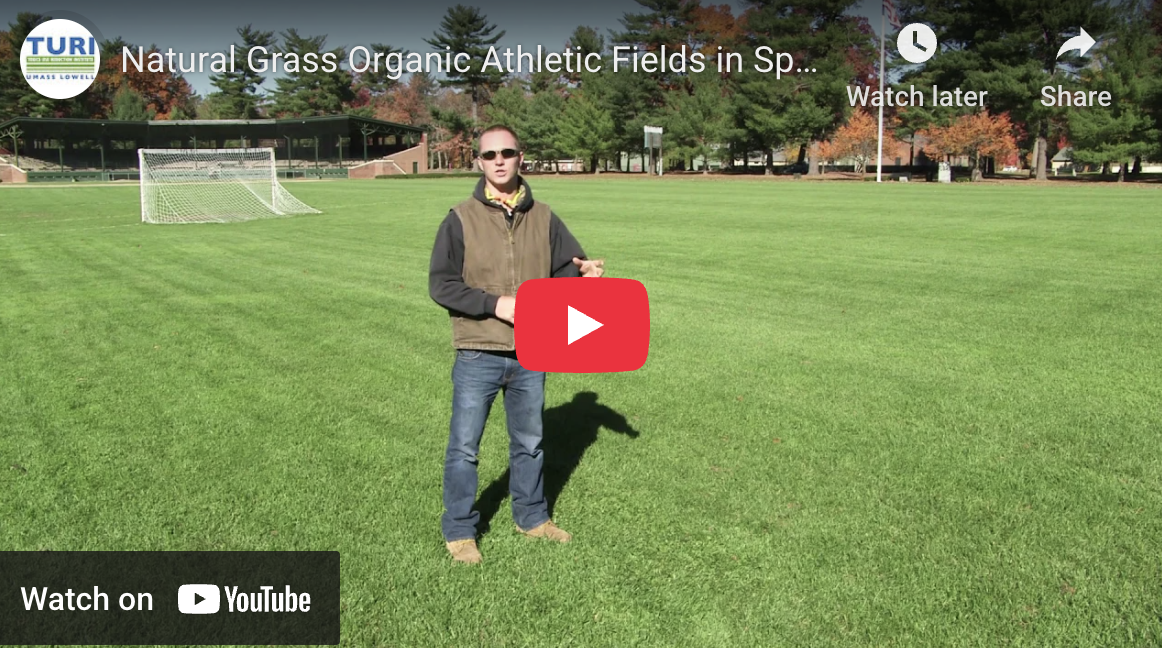
Organically Managed Natural Grass Athletic Fields in Springfield, MA
Featured Video:
Organic Management of Natural Grass