No Need for Regret: A Simple Directive on Chemical Substitution
Written By Karen Thomas, TURI EHS Support Specialist, and Jason Marshall, TURI Lab Director
History is rich with stories of regrettable chemical substitutions. Chemicals thought (even recommended by trusted sources!) to be less hazardous than those in use turn out to be just as hazardous – or even worse – as results of toxicological studies emerge over time. Plasticizers, flame retardants, cleaning solvents – the categories of examples are numerous. Here’s the basic storyline:
- A chemical is functionally- and cost-effective for the manufacturing situation required.
- As health and safety data emerge, the chemical is revealed to be hazardous to human health or the environment or both.
- A new chemical – often with a very similar chemical structure – is adopted as replacement.
The replacement chemical might work well too – perhaps precisely because it is similar in chemical

composition and structure. Users must evaluate the effectiveness of the alternative and sometimes accept a cost increase. What this replacement chemical may lack is complete health and safety data, yet it is used until the data catches up with it.
Does it also make sense that what makes it function similarly to the original chemical (remember, it is structurally similar) would also make it behave similarly in the human body or in the natural environment? Yes? Maybe? Not always, not without exception, of course, but let’s go with YES!
As the science of toxicology moves away from animal testing, previously relied upon animal data will not be available. Now we have a choice. We could spend years debating the validity of data derived from new testing methods or predictive toxicology models. Or we could rely on decades of the lived experience of regrettable substitutes and TURI’s 35+ years of toxics use reduction expertise to declare today:
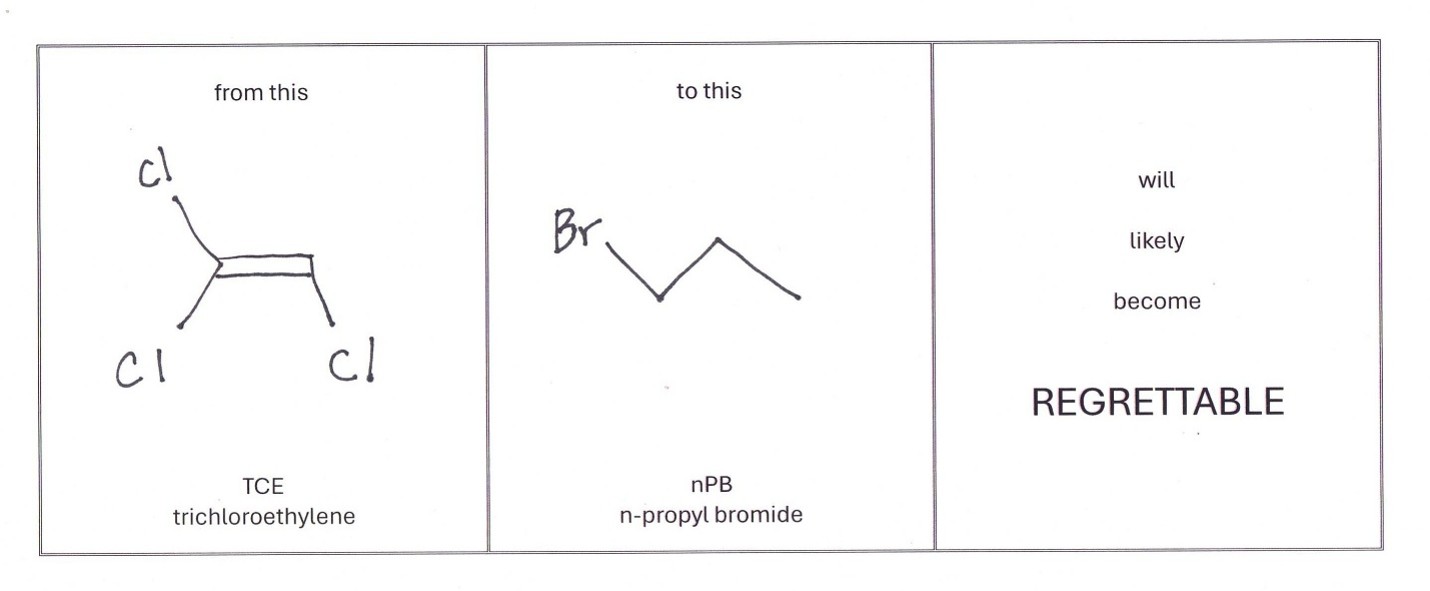
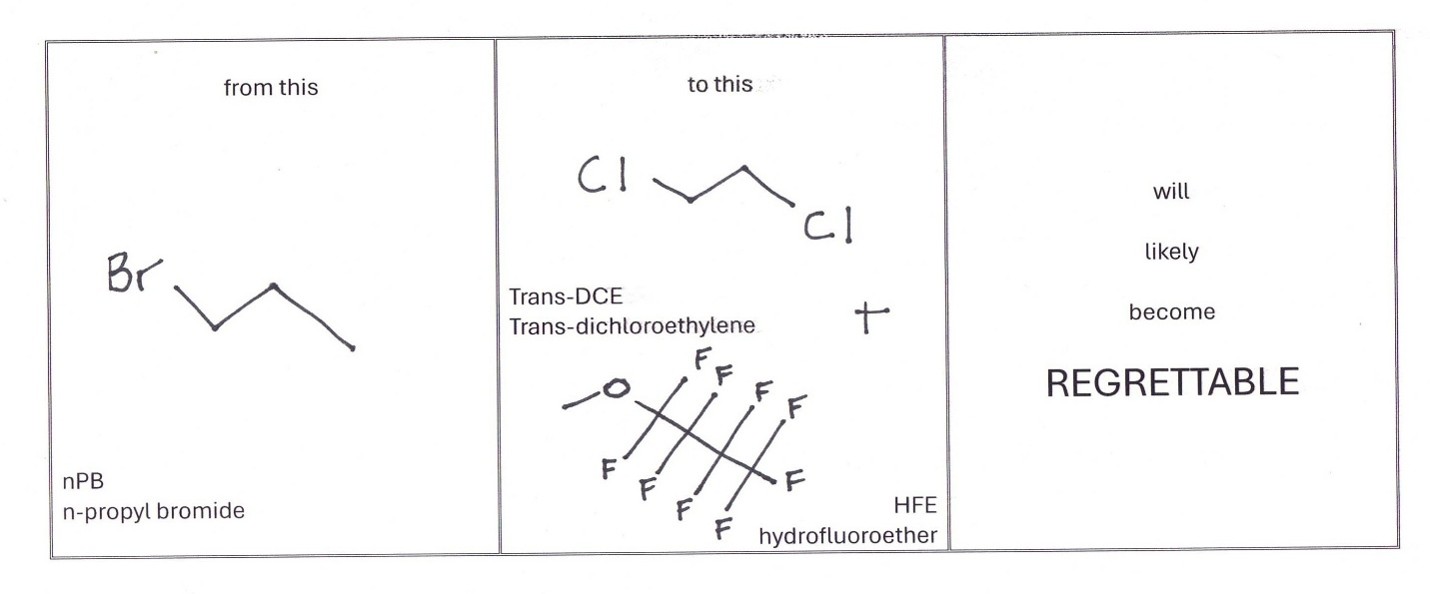
Substitution of a halogenated (e.g., fluorine, chlorine, bromine) cleaning solvent for another halogenated cleaning solvent will likely become a regrettable substitution.
For example, DO NOT switch from trichloroethylene (TCE) to n-propyl bromide (nPB)
DO NOT switch from n-propyl bromide (nPB) to trans 1,2 dichloroethylene (transDCE)/hydrofluoroether (HFE) blend
Save your company the cost of making a substitution that history tells us will likely require another chemistry change once the hazard data catches up. For example, a Massachusetts electronics company switched from perchloroethylene to n-propyl bromide in order to continue using their existing degreasing equipment but then worked with the TURI Lab to find and eventually switch to an aqueous cleaner as they strived to continue to improve their environmental, health and safety profile.
The TURI Lab has the solution for your substitution situation! The TURI Lab helps companies stay ahead of surprises associated with the next iteration of adverse toxicological information. The TURI Lab is ready to assist your facility in identifying and implementing process- or application-specific changes that will be a long-term solution. Whether you need chemistry or equipment testing for your particular process specifications, assistance comparing hazard information between alternatives, or to learn about substitutions that other companies have made, the TURI Lab has the expertise! Services are free for Massachusetts companies.
For more information:
P2OASys: TURI’s Pollution Prevention Options Analysis System (P2OASys) tool helps companies determine whether the toxics use reduction (TUR) options they are considering will improve upon their existing process with respect to environmental, health and safety metrics.
CleanerSolutions: TURI’s CleanerSolutions database provides easy access to more than 30 years of testing information. The fields are searchable by contaminants, substrate, equipment, original and alternative chemistries and vendor data.
TURI nPB factsheet (2026) https://www.turi.org/publications/npb-summary/
TURI TCE factsheet (2021) https://www.turi.org/publications/trichloroethylene-fact-sheet/
New Method Plating Eliminates TCE Use with Enclosed Vacuum Vapor Degreasing Cleaning System (2025) https://www.turi.org/publications/new-method-plating-eliminates-trichloroethylene-tce-use-with-enclosed-vacuum-vapor-degreasing-cleaning-system/
Environmental Health and Safety Summary of transDCE (2024) https://www.turi.org/wp-content/uploads/2024/10/DRAFT_EHS_Summary_TransDCE.pdf
Toxics Use Reduction Program Advisory on transDCE (2019) https://www.turi.org/wp-content/uploads/2024/02/Trans-DCE-Advisory.-2019.pdf
Alternatives to Hazardous Solvents Used in Surface Cleaning (2021) https://www.turi.org/publications/alternatives-to-halogenated-solvents-used-in-surface-cleaning/

